The Best Cookware Sets
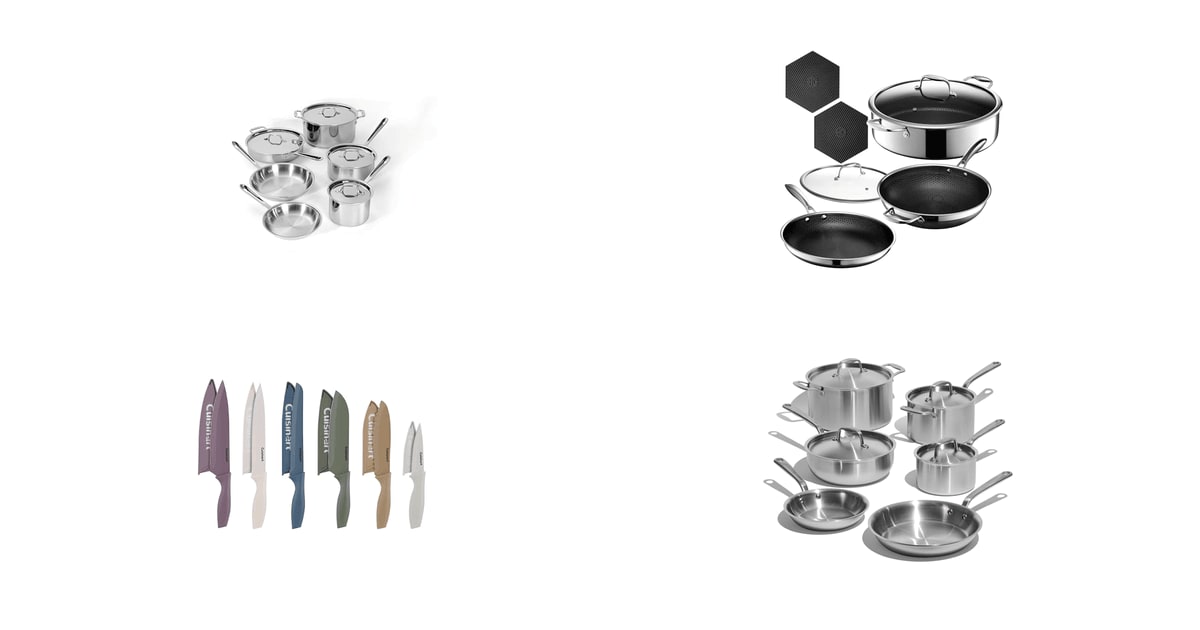
Cookware is the rare kitchen purchase you touch every single day. A good set heats evenly, so your onions brown instead of scorching in one spot while sitting raw in another. It stays put on the burner instead of warping into a wobble. The handles stay cool enough to grab without a towel, and the lids actually fit. Most people buy one set and live with it for years, so the difference between a good one and a bad one compounds over thousands of dinners.
Here's the honest part: no single set does everything well. Stainless steel sears beautifully and lasts basically forever, but it'll stick and frustrate you until you learn to preheat properly. Nonstick makes eggs effortless, then wears out in a few years and needs replacing. Hybrid surfaces split the difference and cost a lot for the privilege. And every set on the market pads its piece count with lids, so a twelve-piece set might give you six actual pans. You're choosing which compromise you'd rather live with.
We read published reviews, compared spec sheets and worked through what owners report over months of real use to sort out which sets earn their keep. Stainless steel dominates the recommendations here because it's the material that survives long enough to be worth buying once. But if you want easy cleanup or you're working with a tiny kitchen, there are better answers. We think that the All-Clad D3 Stainless Steel 10 Piece Cookware Set is the best cookware set for most people, and that the Made In 10 Piece Stainless Steel Pot and Pan Set is the one to buy if you want heavier, more heat-stable pans and don't mind the extra weight.
Everything we recommend

Even heat and a lifetime warranty, if you'll learn the technique
Thicker pans that hold temperature better, at a real weight cost

Sears and releases in one pan, for a lot of money and few pieces

Easy eggs and half the cabinet space, but skip it on induction
How we picked
Even heating. We prioritized sets with fully bonded construction — aluminum sandwiched in stainless from base to rim — over disc-bottom pans that hot-spot at the burner ring. Published reviews and spec sheets both draw a hard line here.
Oven ceiling. We looked for sets that let you finish food in the oven or under a broiler. Anything rated below about 450°F rules out too many everyday techniques to be a general recommendation.
Induction compatibility. We checked every set for a magnetic exterior layer, since induction ranges are increasingly standard in new construction. A set that only works on your current cooktop is a short-term buy.
Real piece count. We counted cooking vessels separately from lids and trivets. A twelve-piece set with six lids gives you six pans, and we compared sets on what you can actually cook in.
Coating longevity. For anything with a nonstick element, we weighed owner reports of how release performance holds up over months of regular use, along with the manufacturer's stated care requirements.
Top pick
Even heat and a lifetime warranty, if you'll learn the technique
All-Clad D3® Stainless Steel 10 Piece Cookware
The All-Clad D3 is a tri-ply stainless set built in Pennsylvania, with an aluminum core bonded all the way to the rim. It heats evenly, handles anything you throw at it, and it's covered by a limited lifetime warranty against defects.
$799.95fromAmazonThe bonded construction goes all the way up the sides, not just across the bottom. A lot of cheaper pans put a thick aluminum disc on the base and leave the walls thin. That's where hot spots come from. All-Clad bonds aluminum between two layers of stainless from base to rim, so the whole pan heats together. In practice, that means your risotto doesn't scorch in a ring where the burner sits.
It's oven and broiler safe to 600°F, which unlocks the techniques you actually want. Sear a steak on the stovetop, slide the whole pan under the broiler to finish. Roast a chicken. Start a frittata on the burner and bake it through. No nonstick set here comes close to that ceiling, and it's the single biggest reason to own stainless.
The 18/10 stainless interior won't react with acidic food. Simmer tomato sauce for three hours, reduce a bottle of wine, deglaze with lemon — nothing picks up a metallic edge or discolors the pan. Aluminum and cast iron both misbehave here. If you cook Italian, Indian or anything with vinegar in it, this matters more than most people realize.
Every piece works on any cooktop, including induction. The magnetic stainless exterior means the set follows you if you move or renovate. That's a real consideration given how many new kitchens are going induction. Buying cookware that only works on your current range is a quiet way to guarantee you'll be shopping again.
Ten pieces cover almost everything without redundancy. You get 8- and 10-inch fry pans, 2- and 3-quart saucepans with lids, a 3-quart sauté pan with a lid, and an 8-quart stockpot with a lid. That's weeknight dinners, pasta night, stock, and braises. The flared rims pour without dribbling down the side, which sounds trivial until you've mopped up stock twice.
Flaws but not dealbreakers
It's the kind of purchase that hurts once. This is one of the most expensive sets here, and it's a real barrier. If you're furnishing a first apartment, this probably isn't the moment. The math works over twenty or thirty years, but that's cold comfort when you need pans this week.
Stainless sticks until you learn to preheat. There's a genuine learning curve, and beginners get discouraged fast. You have to heat the pan properly, add fat at the right moment, and leave the protein alone until it releases on its own. It clicks after a few weeks of practice. But the first few eggs will be a mess.
These pans are heavy, and hand-washing is the recommendation. The 12-inch skillet is a two-hand affair when it's full, and the whole set runs 26 pounds. All-Clad recommends hand-washing even though the pans survive a dishwasher, and the riveted handle joints trap grease that needs a scrub brush.
All-Clad backs the D3 set with a limited lifetime warranty against manufacturing defects.
Upgrade pick
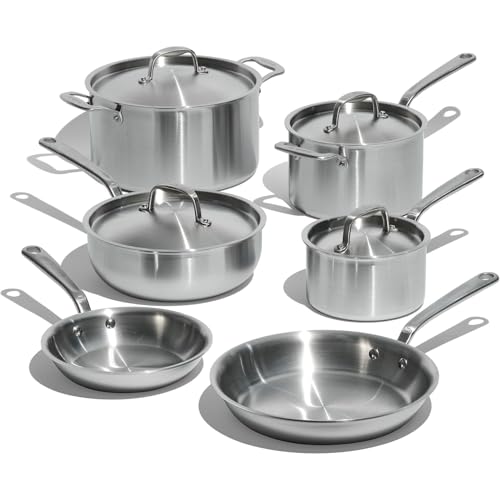
Thicker pans that hold temperature better, at a real weight cost
Made In Cookware
Made In stacks five bonded layers instead of the usual three, so the pans hold their heat when you drop cold food in. It's crafted in Italy and sold direct, and the set includes a saucier that most competitors leave out.
$749.99fromAmazonFive bonded layers hold temperature better than three. The extra mass is the whole point. When you add cold chicken thighs to a hot pan, a thin pan's temperature craters and the meat steams instead of searing. Made In's pans dip less and recover faster. For delicate work — a slow reduction, a custard, a pastry cream — that stability is the difference between smooth and broken.
The set includes a saucier, which is the pan people wish they had. You get a 3-quart saucier with a lid alongside 8- and 10-inch fry pans, 2- and 4-quart saucepans, and an 8-quart stockpot. The saucier's curved walls let a whisk reach every corner, so no lumps hide in the seam. If you make gravy, polenta, or risotto, you'll reach for it constantly.
A 430 stainless outer layer means induction works properly. Made In built the exterior to be magnetic, so the set performs on induction just as well as on gas or electric. Combined with full-clad construction, you're not stuck with a set that only likes one kind of range.
The stay-cool handles and stainless rivets are built for daily grabbing. The handles are shaped to stay cool on the stovetop and riveted rather than welded, which is the more durable joint over decades of use. Riveted handles do collect grease at the joint, but they don't loosen the way welds eventually can.
Flaws but not dealbreakers
These pans are noticeably heavier than tri-ply. Five layers means more metal, and you feel it every time you lift a full stockpot or shake a skillet. If you have wrist or shoulder trouble, or you like to toss vegetables in the pan, this is a genuine downside rather than a nitpick.
Buying direct means returns go through customer service, not a store. There's no counter to walk up to if something arrives dented. Owners who've dealt with the process report it works, but it takes emails and shipping labels instead of a five-minute errand.
It costs roughly what All-Clad costs, without the same name recognition. You're paying premium money for a brand your relatives haven't heard of. The construction argument is real. But if resale, gifting, or simple confidence matters to you, that's worth weighing.
Also greatOn sale
Sears and releases in one pan, for a lot of money and few pieces
HexClad Hybrid Nonstick 7-Piece Cookware Set
HexClad's laser-etched hex pattern puts raised stainless peaks around recessed nonstick valleys, so one pan can brown a steak and release an egg. It's metal-utensil safe, dishwasher-friendly and oven-safe to 900°F.
$558.90fromAmazonList priceThe hybrid surface genuinely does two jobs. The raised stainless ridges make contact with your food and build the browning and fond you need for a good sear. The recessed ceramic coating between them keeps eggs and fish from welding to the pan. It's not a marketing gimmick — the geometry actually works, which is why it's the only pan here that does both.
You can use metal utensils and run it through the dishwasher. That's rare for anything with a nonstick element. No hunting for the silicone spatula, no babying it in the sink. For anyone who's ruined a nonstick skillet with a stray fork, this alone is a strong argument.
The oven ceiling is the highest of any set here at 900°F. The pans handle broiler heat that would destroy a conventional nonstick coating. The tempered glass lids top out at 400°F, so you pull those off first. But the cooking vessels themselves aren't the limiting factor.
Tri-ply construction with an aluminum core means it heats evenly on any cooktop, induction included. You're not getting a thin nonstick pan with a coating sprayed on. The underlying build is the same kind of bonded stack as the stainless sets here, which is a big part of why it costs what it costs.
Flaws but not dealbreakers
Seven pieces is thin for the money. You get a 7-quart chicken fryer with a lid, a 12-inch wok, a 12-inch pan with a lid, and a pair of silicone trivets. There's no saucepan, no sauté pan, no stockpot. Calling this a complete set is generous — for most kitchens it's a partial set at a full-set price.
The nonstick in the valleys wears down over time. The stainless peaks last indefinitely, but the ceramic coating between them doesn't. Owners report release performance fading with heavy use, and there's no way to renew it. The pan stays usable as stainless; it just stops being the pan you bought.
It requires seasoning to work as advertised, and people skip that step. HexClad's instructions call for seasoning before first use, and a lot of the sticking complaints trace back to owners who didn't. If you're expecting an out-of-the-box nonstick experience, you'll be disappointed.
HexClad cookware sold by HexClad carries a lifetime warranty against manufacturer's defects, excluding commercial and restaurant use.
Budget pick
Easy eggs and half the cabinet space, but skip it on induction
Calphalon Premier Space-Saving Nonstick Cookware Set
The Calphalon Premier nests in any order and stacks flat, cutting storage space by about 30%. Its three-layer nonstick interior is metal-utensil safe and dishwasher-safe, and it's the easiest set here to cook on from day one.
$159.99fromAmazonIt solves a storage problem nobody else here addresses. The pans nest in any order and the lids stack flat, so eight pieces take up roughly the footprint of four. If you're working with one cabinet and a drawer, that's not a nice-to-have. It's the reason to buy this set.
The nonstick is forgiving in a way stainless isn't. Eggs slide out without butter. Fish lifts without leaving half the fillet behind. There's no technique to learn and no preheating ritual. If you're cooking for the first time or you just want breakfast without a fight, this is the set that cooperates.
Metal utensils and the dishwasher are both fine. Calphalon's three-layer MineralShield interior tolerates both, which is unusual for nonstick and takes away the two most common ways people destroy a coating. You can still extend its life by hand-washing. But a forgotten pan in the dishwasher isn't a disaster.
Hard-anodized aluminum spreads heat better than cheap stainless. For its price tier, the base does a decent job of avoiding hot spots, and it's oven-safe to 450°F. That's enough for a frittata, baked eggs, or shakshuka — most of what people actually finish in the oven.
Flaws but not dealbreakers
It doesn't work on induction, full stop. Hard-anodized aluminum isn't magnetic, so an induction cooktop won't heat it at all. If you have induction now, or you're renovating soon, this set is off the table. That's the single biggest reason it's not ranked higher.
The coating is on a clock. Nonstick doesn't last forever, no matter how it's marketed. Plan on replacing these pans in a few years, and replace any of them sooner if you see scratching, chipping or flaking. Budget for that when you compare it against a stainless set that'll outlive you.
Lightweight pans can warp under sustained high heat. At about 11 pounds for the whole set, these are thin compared to the clad options here. Blast them empty on high or crank the heat for a long sear and you risk a pan that rocks on the burner afterward.
Who this is for
This guide is for anyone buying cookware in one shot — outfitting a first kitchen, replacing a warped mismatched collection, or upgrading from whatever came with the apartment. If you already own a good skillet and a stockpot you like, a full set is probably the wrong purchase. Buy the two or three pieces you're missing instead. And if your current pans work fine and just look tired, cleaning them with a stainless polish costs a fraction of replacing them.
We're covering multi-piece sets of stovetop cookware here: fry pans, saucepans, sauté pans and stockpots. Cast iron, carbon steel, enameled Dutch ovens and individual open-stock pans are all worth owning, but they're not what this guide compares. One thing to settle before you shop: find out whether your cooktop is induction. Hold a refrigerator magnet to the bottom of a pan you own — if it doesn't stick, that pan won't work on induction, and neither will any set without a magnetic base.
How we picked
We weighed five things. Even heating: fully bonded construction that runs base to rim, not a disc welded to the bottom, because that's where hot spots come from. Oven ceiling: a rating high enough to finish a steak under the broiler or bake a frittata through, which rules out most low-temperature nonstick. Induction compatibility: a magnetic exterior layer, since induction ranges keep gaining ground and a non-magnetic set can't follow you to a new kitchen. Real piece count: cooking vessels counted separately from lids and accessories, so a padded number doesn't win on paper. Coating longevity: for nonstick and hybrid surfaces, how release holds up over months of normal use, and what care the manufacturer actually requires to get there.
The competition
This is what our research turned up among the sets we compared, not a census of everything for sale. Cookware is a crowded category, and plenty of decent sets never surfaced. What follows is the one product in our lineup that didn't earn a recommendation, and why.
The Cuisinart Advantage 12-Piece Kitchen Knife Set ($39.08) — The Cuisinart Advantage 12-Piece Kitchen Knife Set is a cutlery set, not cookware — six nonstick-coated stainless knives with matching color-coded blade guards, backed by a limited lifetime warranty. The color coding is a genuinely useful touch if you want to keep the chicken knife and the vegetable knife straight, and the nonstick coating helps food fall off the blade instead of clinging to it. But knives don't compete with pans on any of the criteria in this guide, so we can't rank it against the sets above. If you need knives, it's a reasonable starter block-free option; it just isn't a cookware set.
Care and maintenance
Stainless pans need preheating, not scrubbing. Get the pan hot before the fat goes in, add your protein, and leave it alone — it releases on its own once a crust forms. If food does stick, deglaze with water while the pan's still warm and it lifts right off. For burnt-on messes, simmer a little water with baking soda instead of reaching for steel wool. Nonstick lives by different rules: no empty pans on high heat, no temperatures above 500°F, and replace any pan showing scratches, chips or flaking. Hand-washing extends coating life by years even on sets labeled dishwasher-safe. And with any riveted handle, get a brush into the joint where grease collects.
Questions we get
What's the difference between nonstick and stainless steel cookware?
Nonstick has a coating — usually PTFE or ceramic — that keeps food from sticking, so eggs and fish come out clean with almost no fat. Stainless has no coating at all, which is why it can take much higher heat, build the browned fond that makes a good pan sauce, and handle acidic food without reacting. The trade is longevity against convenience. Nonstick coatings wear out in a few years; stainless lasts decades but demands technique.
Which is better for everyday cooking?
For most people planning long-term, stainless is the better buy because it handles every task once you learn it and never wears out. Nonstick is clearly better if you're new to cooking, make eggs or fish daily, or care most about easy cleanup. Plenty of experienced cooks own both: one nonstick skillet for eggs, a stainless set for everything else. That's a perfectly sensible way to go.
Which sets work on induction cooktops?
The All-Clad D3, the Made In set and HexClad all have magnetic stainless exteriors and work on induction. The Calphalon Premier does not — its hard-anodized aluminum body isn't magnetic, so an induction burner won't heat it. If you have induction or expect to, cross the Calphalon off your list entirely.
How long does nonstick cookware last?
PTFE coatings generally give you a few years of good release with careful use, and ceramic coatings tend to fade sooner. Metal utensils, high heat and the dishwasher all shorten that clock, though some sets tolerate those better than others. Replace a pan when you see scratching or chipping, when food starts sticking where it used to release, or when any coating flakes off.
Should I worry about PFAS in nonstick pans?
Traditional PTFE coatings are fluoropolymers, and manufacturers universally say not to heat them above 500°F or leave them empty on high heat. Discard any pan with visible scratches or flaking in the coating. If you want to avoid fluoropolymers entirely, the stainless sets here have no coating at all, and HexClad uses a ceramic coating rather than PTFE.
Is a 12-piece set really better than an 8-piece set?
Not necessarily, and this is the most common way piece counts mislead. Manufacturers count lids, and sometimes trivets, as pieces. A twelve-piece set with six lids gives you six actual pans — the same as an eight-piece set with two lids. Count the cooking vessels before you compare sets on size.
Why you should trust us
For this guide:
- We compared manufacturer specifications across every set here, focusing on construction layers, oven ratings and induction compatibility.
- We read published reviews from established cookware testing outlets and weighed their conclusions against each set's stated build.
- We reviewed owner feedback themes for each product, paying particular attention to how coatings and handles hold up after months of regular use.
- We read owner reviews on every listing, weighted toward the critical ones, because that is where the recurring failures show up.
- We have a systematic way of automatically fetching the latest prices, so the numbers on this page stay current.
- This is a research-focused guide, so the team may not own every product listed — though we often do own the top winners, which gives us extra context for the recommendations.
- We don't accept free products, and the retailer commission never changes which product we recommend.
Sources
The Best Cookware Sets of 2026, Wirecutter (New York Times)
Best Cookware Sets, America's Test Kitchen
Best Cookware Sets, Tested by the Good Housekeeping Institute, Good Housekeeping
The Best Cookware Sets, Tested and Reviewed, Serious Eats
Best Cookware Sets, Consumer Reports
The Best Cookware Sets for Every Budget, Epicurious
PFAS in Cookware: What You Need to Know, Environmental Working Group
Cookware Materials Guide, Cook's Illustrated
Amazon product listings and owner reviews for all 5 products
Manufacturer specification pages for each product
Some passages in this guide may be paraphrased with AI help. Prices are refreshed automatically.
More like this.
Continue exploring appliances reviews and recommendations.

The Best Food Processors
A food processor pays for its counter space in ten-minute chunks. It shreds a block of cheddar before your pan is hot. It turns a pile of onions, carrots…

The Best Mandoline Slicers
A mandoline turns a tedious job into a fast one. Potato gratin, cucumber salad, apple chips, shaved fennel - slices that would take you ten careful…

The Best Waffle Makers
A waffle maker earns its counter space about once a week, on a slow morning, when someone in the house wants something better than toast. That's a low bar…

The Best Cocktail Shaker Sets
A cocktail shaker is the one bar tool you can't fake. It chills, it dilutes, and it aerates all at once, and a shake that leaks down your wrist ruins the…

The Best Knife Sharpeners and Honing Tools
A sharp knife does the work so your hands don't. It glides through tomato skin instead of skidding off it, and it takes most of the fight out of a…

The Best Food Dehydrators
A dehydrator is a slow appliance that quietly saves you money. It pulls 80 to 95 percent of the moisture out of food, which drops water activity below the…