The Best Kitchen Knife Sets
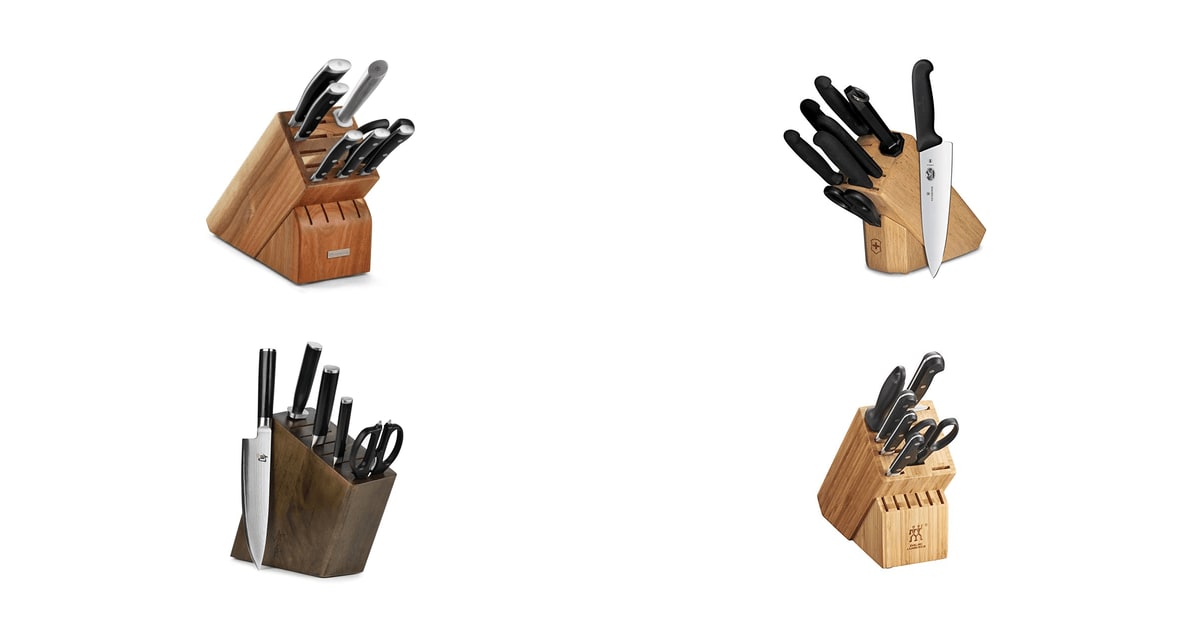
A sharp knife changes how cooking feels. You stop sawing at tomatoes, you stop crushing herbs into a bruised green paste, and dinner prep gets faster and safer. A dull blade slips; a sharp one bites where you put it. Most of us reach for the same chef's knife three or four times a day, which makes a knife set the rare kitchen purchase you'll actually touch every single meal. The gap between a bargain block and a serious one shows up in the first five minutes.
But no knife set is a complete answer, and every one of them ships with pieces you won't use much. Blocks pad their piece counts with steak knives and shears, so a 15-piece set often means eight real prep knives. None of these blades stay sharp on their own, either. You'll be honing regularly and putting them on a whetstone once or twice a year, no matter what you spend. And a block eats counter space that a magnetic strip wouldn't.
So the right set depends less on the brand badge than on what you cook and how much maintenance you'll actually do. Heavier German steel forgives rough handling and resharpens easily. Harder Japanese steel slices finer but chips if you hit a bone. We think that the Wüsthof Classic 8-Piece Knife Block Set is the best kitchen knife set for most people, and that the Victorinox Fibrox Pro 8-Piece Knife Block Set is the one to buy if you want professional-grade cutting without a premium outlay.
Everything we recommend

The set that handles everything and asks little of you
Professional-kitchen performance without the forged-steel premium

Sharper than anything else here, if you'll care for it properly

An arched bolster that teaches your hand the right grip

Total kitchen coverage without a premium-set outlay
How we picked
Steel and hardness. We compared published hardness figures and alloy specifications across every set, looking for German steel in the 55–58 HRC range or Japanese steel above 60 HRC. Anything outside those bands either dulls too fast or chips too easily for home use.
Edge out of the box. We read professional review coverage on factory sharpness and bevel angle, since a set that needs sharpening before its first meal starts from behind. Sets with laser-ground or precision-sharpened edges scored higher.
Handle and balance. We weighed reviewer and owner accounts of grip security, weight distribution and fatigue during long prep sessions. Slippery handles and blade-heavy balance were disqualifying.
Real piece count. We counted actual prep knives separately from steak knives, shears and honing steels. A set advertised as fifteen pieces is often an eight-knife set with a dinner-table bonus.
Warranty and track record. We limited the guide to manufacturers with standing repair and replacement programs and decades of documented service. A lifetime warranty from a brand with no history behind it isn't worth counting.
Top pick
The set that handles everything and asks little of you
Wüsthof Classic 8-Piece Knife Block Set
The Wüsthof Classic is the German forged set that professional cooks name first. Its steel holds an edge through weeks of cooking, resharpens with a basic honing rod, and the block covers every task a home kitchen throws at it.
$695fromAmazonIt's the set that shows up at the top of independent knife rankings year after year. Wüsthof has been forging in Solingen since 1814, and the Classic line is its flagship. Published reviews consistently name the Classic 8-inch chef's knife the best all-purpose chef's knife you can buy. That's not brand nostalgia. It's what happens when a company makes the same blade shape for two centuries and keeps refining the grind.
The steel hits a sweet spot you'll appreciate. The X50CrMoV15 alloy is hardened to 58 HRC, which is hard enough to keep a working edge through weeks of regular cooking. But it's soft enough that a standard honing rod straightens things out between real sharpenings. You don't need diamond stones or a specialty kit. A rod, thirty seconds, and you're back to slicing tomatoes cleanly.
Precision Edge Technology means it's sharp out of the box, not eventually. Wüsthof grinds each blade with a laser-guided process to a 14-degree bevel per side — noticeably keener than the 20-degree standard German knives used for generations. That's about 20% sharper than earlier Wüsthof generations. You won't need to sharpen it before the first meal, which is more than you can say for a lot of blocks.
The balance point sits right where your hand wants it. Weight centers at the bolster rather than out in the blade or back in the handle. That's what makes rocking through a pile of shallots feel controlled instead of tiring. Reviewers who compare it against similarly priced competitors keep coming back to that balance as the differentiator. Pick it up and it feels like it knows what it's doing.
Eight pieces plus a lifetime warranty is a genuinely long-term buy. You get a chef's knife, bread knife, utility knife, paring knife, four steak knives, kitchen shears, and a honing steel in a 14-slot acacia block. Wüsthof backs the whole thing for life, and the company actually honors it. Spread across twenty years of daily cooking, this is a set you buy once.
Flaws but not dealbreakers
It's heavy, and you'll feel it during long prep. German forged construction means a substantial knife, and if you're breaking down a case of vegetables, your wrist notices. Cooks coming from lightweight Japanese blades often find the Classic tiring at first. Most people adapt within a week. But if you have small hands or wrist issues, this isn't the set for you.
Four of the eight pieces are steak knives. That leaves you with four actual prep knives — chef's, bread, utility, paring. It's a sensible core, but you're paying block-set money and giving up four slots to cutlery you'll use at dinner parties. If you never host, that's dead weight in your block.
The POM handles are practical, not warm. They're durable, hygienic, and they won't crack or absorb moisture. They also look and feel like high-grade plastic, because that's what they are. Next to a PakkaWood handle they're plainly the less beautiful option.
The Wüsthof Classic set carries a lifetime warranty from Wüsthof.
Budget pickOn sale
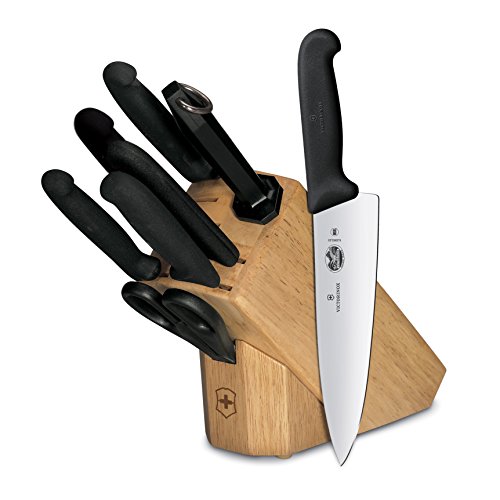
Professional-kitchen performance without the forged-steel premium
Victorinox Fibrox Pro 8-Piece Knife Block Set
The Victorinox Fibrox Pro is the set restaurant kitchens actually buy. Stamped Swiss steel and grippy textured handles give you real cutting performance for a fraction of what forged German sets cost, and the edge is genuinely easy to restore at home.
$212.15fromAmazonList priceThese are the knives working cooks reach for, not the ones they display. Victorinox stamps them in Switzerland from high-carbon stainless steel and laser-checks each blade for sharpness during manufacturing. Published head-to-head reviews have put the Fibrox 8-inch chef's knife against forged German knives costing three times as much, in timed prep tasks, and found it holds its own. That's not a fluke result. It's been the finding for years running.
The Fibrox handle stays put when your hands are slick. Victorinox's textured thermoplastic grip is NSF-certified for commercial kitchens, where slip resistance under wet, greasy conditions is a legal requirement, not a nice-to-have. If you've ever had a knife twist in your hand while breaking down a chicken, you'll appreciate this. It's also dishwasher-tolerant, though we'd still wash by hand.
Stamped and light means less fatigue on marathon prep. The blades are die-cut from cold-rolled sheet rather than forged from a bar, so they weigh noticeably less than the Wüsthof. Plenty of professionals prefer exactly that when they're prepping for four hours straight. Lighter isn't worse — it's a different tool for a different rhythm.
Softer steel is the easiest thing here to resharpen. At roughly 56 HRC, the edge rolls sooner than the premium sets, but it comes back fast. A few passes on an 800-grit whetstone, or even a decent pull-through sharpener, restores a working edge in under five minutes. If you've never sharpened a knife, this is the set to learn on.
You get a genuinely complete working kit and a lifetime warranty. The block holds an 8-inch chef's knife, 8-inch bread knife, 6-inch boning knife, 5-inch utility knife, 3.25-inch paring knife, kitchen shears, and a honing steel across 11 slots. Victorinox stands behind all of it. For a first kitchen, a rental, or a shared house, it's hard to argue with.
Flaws but not dealbreakers
The edge won't last as long as the forged sets. Owners consistently note that the Fibrox needs honing more often — realistically before most cooking sessions to keep it slicing cleanly. That takes about thirty seconds at the rod. But if you'd rather sharpen twice a year and forget about it, the Wüsthof is the better fit.
There's no bolster, and the block is plain. Without a bolster, the blade-to-handle transition gives your guiding index finger less protection. It's a small thing that becomes noticeable during fast work. The block itself is purely functional — nobody's complimenting it on your counter.
Stamped blades lack the rigidity you feel in forged steel. There's a slight flex and a lightness that reads as less authoritative in the hand. For most home cooking it doesn't matter. For heavy work like cutting through a squash, you'll wish for more heft.
Victorinox backs the Fibrox Pro set with a lifetime warranty.
Upgrade pick
Sharper than anything else here, if you'll care for it properly
Shun Classic 6-Piece Knife Block Set
The Shun Classic is a Japanese set built around a VG-MAX steel core hardened to 61 HRC with 68 layers of Damascus cladding. It slices fish and vegetables paper-thin, and it demands whetstone care and careful handling in return.
$529.95fromAmazonIt's meaningfully sharper than every German set in this guide. The VG-MAX core is a proprietary alloy with elevated chromium, cobalt, vanadium and tungsten, hardened to 61 HRC — three full points harder than the Wüsthof. That hardness supports a 16-degree bevel per side. On a ripe tomato or a piece of raw fish, the difference isn't subtle. You get clean, thin cuts with almost no downward pressure.
Thin blade geometry does things German knives can't. If you chiffonade basil, julienne carrots or want translucent slices of radish, the Shun's thinner stock and more acute grind genuinely outperform a thicker German blade. Published reviews of Japanese sets single out precisely these tasks. For anyone cooking a lot of vegetables or working with fish, it's the right tool.
The Damascus cladding isn't just decoration. Sixty-eight alternating layers of hard and soft steel wrap the core, and the resulting micro-corrugations along the blade face reduce contact with what you're cutting. Potato slices stick less. It also gives the blade that rippled look, which is the reason half the people who buy this set buy it.
The D-shaped PakkaWood handles are the nicest in this guide. They're warm, comfortable, and the asymmetric shape naturally seats a right-handed pinch grip. Compared with the POM and thermoplastic handles elsewhere here, they feel like something you'd want on display. Shun also runs a dedicated sharpening service program, and the set carries a lifetime warranty.
Flaws but not dealbreakers
Hardness cuts both ways — this blade chips. At 61 HRC, the steel is brittle. Chicken vertebrae, frozen food, a sideways twist during a cut, or a tip-first drop onto a tile floor will all take a piece out of the edge. Owners report chipping more often with Shun than with any German set, and it's usually a technique problem rather than a defect. You have to change how you cut.
Maintenance is genuinely more demanding. A standard honing steel will micro-crack this steel over time, so it's off the table. You need diamond whetstones or a fine stone above 2000 grit, plus the patience to learn the angle. If that sounds like a chore, buy the Wüsthof instead. And use only wood or quality plastic boards — never glass or ceramic.
Six pieces, no steak knives, no honing steel. You get a chef's knife, paring knife, utility knife, bread knife, shears and a 6-slot bamboo block. That's a lean kit for premium money. The D-shaped handle also favors right-handed cooks; lefties should look at Shun's dedicated left-hand models rather than fighting this one.
The Shun Classic set is covered by a lifetime warranty.
Also greatOn sale
An arched bolster that teaches your hand the right grip
Zwilling Pro 7-Piece Knife Block Set
The Zwilling Pro is German forged steel with one clever addition: a curved bolster that guides your index finger onto the blade spine automatically. If you're moving up from cheap knives, it makes a proper pinch grip feel natural on day one.
$341.04fromAmazonList priceThe arched bolster is a real ergonomic improvement, not marketing. Instead of a flat, perpendicular blade-to-handle transition, Zwilling curves the bolster's lower edge forward. Your index finger slides onto the blade spine without you thinking about it. That's the pinch grip taught in every culinary program, and most sets take weeks of conscious retraining to adopt. This one makes it instinctive.
FRIODUR ice-hardening produces a tougher, springier blade. After forging, Zwilling cryogenically quenches the steel at minus 94°F, converting residual austenite to martensite. The result sits around 57 HRC with better elastic flex recovery than conventionally quenched steel of the same alloy. That matters for boning and filleting, where you can't avoid torquing the blade a little.
The weight distribution suits a rocking chop. Full bolster-to-tip balance gives you a knife that wants to rock through herbs and onions on a hardwood board. Published comfort testing has singled out the Pro chef's knife as the most comfortable German-style option for sustained chopping, crediting the bolster shape and forward weight. If you mince a lot, you'll feel it.
Zwilling has been in Solingen since 1731, and it shows in the finish. The satin-polished blades hide daily scratches better than a mirror finish, and parts and service availability from a company this old is about as safe a bet as exists in cutlery. The seven pieces cover an 8-inch chef's knife, a 6-inch chef's knife, a 5.5-inch prep knife, a 4-inch paring knife, an 8-inch bread knife, a honing steel and the block.
Flaws but not dealbreakers
That bolster complicates sharpening. Because it curves down toward the heel, you can't run the full blade length flat across a whetstone. You'll need to adjust your angle at the heel or accept that the last inch stays duller. It's a fair trade for the grip benefit, but it's a real annoyance if you sharpen at home.
No kitchen shears, and only seven pieces. Competing sets at this tier include shears as a matter of course. It's a small omission that feels conspicuous. Seven pieces also makes this the smallest of the premium German sets here, so plan on buying a few things separately.
It's heavy, and less familiar than Wüsthof. The full bolster adds heft that anyone used to lighter Japanese knives will notice immediately. Zwilling also carries less name recognition in professional culinary programs than Wüsthof, which matters mainly if you care what your cooking-school friends think.
Zwilling backs the Pro set with a lifetime warranty.
Runner-up
Total kitchen coverage without a premium-set outlay
Henckels Classic 15-Piece Knife Block Set
The Henckels Classic 15-Piece fills every gap at once — carving knife, boning knife, six steak knives, shears and more. The steel isn't premium and the blades won't hold an edge like Wüsthof, but nothing is missing.
$249.95fromAmazonIt solves the missing-piece problem in one purchase. You buy an 8-piece block, then discover you need a boning knife for whole chickens, a carving knife for the holiday roast, and matching steak knives when people come over. The Henckels Classic hands you all of it up front: 8-inch chef's, 8-inch bread, 8-inch carving, 6-inch utility, 5-inch boning, 4-inch paring, six 4.5-inch steak knives, shears, honing steel and a 16-slot block.
The German stainless steel is consistent and predictable. It's the entry-to-mid tier of the Zwilling J.A. Henckels family — the single-man logo rather than the twins — and it performs like it. Reviewers have found the primary knives, particularly the chef's and bread knives, sharp and capable out of the box. They're not heirloom blades. They're reliable ones.
Triple-riveted polypropylene handles hold up to family life. They're durable, comfortable in hand, and tolerant of the occasional dishwasher run, though we'd still hand-wash. If your knives get used by teenagers, houseguests and whoever's cooking that night, that forgiveness is worth more than a prettier handle.
The full-bolster prep knives give you a traditional German feel at a mid-range price. You get the weight-forward balance and finger protection that make chopping feel secure, on the knives you'll actually reach for daily. Henckels also backs the set with a lifetime warranty, and the company has a real track record of honoring service and replacement claims.
Flaws but not dealbreakers
Seven of the fifteen pieces aren't prep knives. Six steak knives and a pair of shears means your effective prep count is around eight. That's still generous, but don't read 15 as fifteen knives you'll use for cooking. The math matters when you're comparing sets.
Edge retention is the weak spot. The steel sits around 57 HRC and several secondary blades are stamped rather than fully forged. Independent testing has found the Classic performs well on initial sharpness but falls behind premium competitors after simulated heavy use. In practice, you'll be honing more often than a Wüsthof owner does.
The block is big and the finish is plain. A 16-slot hardwood block takes serious counter real estate, and the blade finish reads as less refined than the German and Japanese sets above. If your kitchen is small or you care how the block looks, this isn't the one.
The Henckels Classic set comes with a lifetime warranty.
Who this is for
This guide is for anyone equipping a kitchen from scratch or replacing a tired block — first-time homeowners, cooks who've been getting by with a drawer full of mismatched knives, and families who want one purchase to cover everything. If you cook a few times a week and want sharper, safer, faster prep, a set from a serious cutlery brand is the single upgrade that pays back most. All five sets here come with blocks, which is the right call if you want storage sorted alongside the knives.
It's not for everyone, though. If you already know exactly what blade geometry and handle shape you prefer, you'll get more from three excellent individual knives than from any block of mid-grade steel. An 8-inch chef's knife, a 3.5-inch paring knife and a serrated bread knife handle nearly all home prep, and a fourth utility or boning knife covers the rest. We also stick to block sets here — magnetic strips, in-drawer trays and open-stock single knives are outside what this guide covers, as are the sub-brand blocks sold in big-box stores.
How we picked
Steel and hardness: We looked for German alloys around 55–58 HRC that resharpen easily at home, or Japanese steel above 60 HRC that holds a finer edge, and we ruled out anything that fell between the two stools. Edge out of the box: Published coverage of factory sharpness and bevel angle told us which sets arrive genuinely ready to cook with. Handle and balance: Reviewer and owner accounts of grip security and fatigue during long prep sessions carried real weight, since a slippery handle is a safety problem, not a preference. Real piece count: We counted prep knives separately from steak knives and shears, because a fifteen-piece set is often an eight-knife set. Warranty and track record: We only considered brands with standing repair programs and decades of service history behind the promise.
The competition
These five sets are what our research surfaced as the strongest and most consistently recommended block sets from established cutlery makers. They aren't the whole market. Plenty of respected names — Global, MAC, Miyabi, Made In and others — sell excellent knives we didn't look at here, and open-stock single knives are a legitimate alternative to any block. Every product in this guide earned a spot among our picks, so there's nothing sitting in the also-ran column.
Care and maintenance
Hone before any serious prep session. A few strokes on a honing steel realigns the edge without removing metal, and that one habit stretches the gap between real sharpenings from monthly to yearly. Plan on a whetstone once or twice a year — a 1000/6000 combination stone and twenty minutes gets you close to a factory edge, and it removes far less metal than an electric sharpener. Hand-wash and dry immediately; knives left soaking will corrode at the rivets even in good stainless. Use wood or quality plastic boards only, since glass, ceramic and very hard bamboo dull edges faster than sharpening can keep up with. Skip the dishwasher entirely, and never put a standard steel rod to a Japanese blade above 60 HRC.
Questions we get
What's the best kitchen knife set for a beginner?
The Victorinox Fibrox Pro is where we'd start. The handles are grippy and forgiving, the softer steel resharpens without special equipment, and the set covers every fundamental task from day one. You can build real cutting technique without worrying about chipping a fragile Japanese edge. Once you know what you like in a knife, upgrading becomes a much better-informed decision.
Japanese or German knives — which should I get?
It depends on how you cook and how much maintenance you'll actually do. German knives at 56–58 HRC are tougher, handle butternut squash and rough treatment without complaint, and resharpen with standard gear. Japanese knives above 60 HRC hold a finer edge and slice fish and vegetables far more cleanly, but they chip on bones and need diamond whetstones. Most home cooks are better served by German steel.
Is a 15-piece set actually worth it?
Only if you'll use the extras. Most home cooks need four knives: an 8-inch chef's, a 3.5-inch paring, a serrated bread knife, and a utility or boning knife. A 15-piece set makes sense if you entertain regularly and want matching steak knives, or if you carve roasts and break down whole birds. Cook for one or two and rarely host, and three great knives will serve you better than fifteen mediocre ones.
How often do I need to sharpen my knives?
Full whetstone sharpening once or twice a year covers most home cooks. In between, hone before any real prep session — that realigns the edge without removing steel. Use the paper test to check: hold a sheet vertically and draw the blade down. If it catches or tears instead of slicing cleanly, hone it; if honing doesn't fix it, it's whetstone time.
Can I put any of these knives in the dishwasher?
No, and it's not a close call. Alkaline detergent is abrasive, the heat cycling warps handle materials, and blades knocking together in the cutlery basket chip and dull edges fast. A year of dishwasher runs will wreck both the edge geometry and the handles. Rinse with warm water, wipe dry, and put them back in the block.
Should I buy a set or build a collection one knife at a time?
Building piece by piece gets you better performance for the money if you're willing to research and buy over time — best chef's knife from one brand, best paring knife from another. But sets give you matching pieces, a storage block, and a finished kitchen in one decision. For most people a good set is the practical answer. Serious cooks with settled preferences usually end up with a mixed collection anchored by one outstanding chef's knife.
Why you should trust us
For this guide:
- We read published knife reviews and long-running comparison coverage from established test kitchens and consumer publications to see which chef's knives keep placing at the top.
- We compared manufacturer specifications for each set — steel alloy, Rockwell hardness, bevel angle, construction method and piece count — rather than relying on marketing descriptions.
- We reviewed owner feedback themes across these sets to identify the failure modes buyers actually run into, particularly chipping on harder Japanese steel and how quickly softer stamped blades need honing.
- We read owner reviews on every listing, weighted toward the critical ones, because that is where the recurring failures show up.
- We have a systematic way of automatically fetching the latest prices, so the numbers on this page stay current.
- This is a research-focused guide, so the team may not own every product listed — though we often do own the top winners, which gives us extra context for the recommendations.
- We don't accept free products, and the retailer commission never changes which product we recommend.
Sources
The Best Chef's Knife — Wirecutter (New York Times), Wirecutter
The Best Kitchen Knife Sets — Serious Eats, Serious Eats
Knife Set Equipment Reviews — America's Test Kitchen, America's Test Kitchen
Best Kitchen Knife Sets — Good Housekeeping Institute, Good Housekeeping
Best Kitchen Knife Sets Tested — Food & Wine, Food & Wine
Best Kitchen Knife Sets — CNET, CNET
Best Knife Sets — The Spruce Eats, The Spruce Eats
Knife Sets Ratings and Reviews — Consumer Reports, Consumer Reports
Amazon product listings and owner reviews for all 5 products
Manufacturer specification pages for each product
Some passages in this guide may be paraphrased with AI help. Prices are refreshed automatically.
More like this.
Continue exploring appliances reviews and recommendations.

The Best Handheld Vacuums for Car and Pet Hair
Pet hair doesn't sit on car upholstery. It works its way into the weave, and a plain suction nozzle glides right over the top of it. That's the whole…

The Best Dishwashers
A dishwasher is one of the few appliances you'll interact with every single day, and the differences between a good one and a mediocre one show up fast.…

The Best Countertop Toaster Ovens
Most of the time, a toaster oven isn't cooking dinner. It's reheating two slices of pizza, browning a tray of frozen nuggets, or making toast while the…

The Best Electric Tankless Water Heaters
A tankless water heater doesn't store anything. It heats water as it flows past, which means you're not paying to keep fifty gallons warm while you're at…

The Best Electric Turkey Roasters
Thanksgiving has one real bottleneck, and it's your oven. The bird sits in there for hours while the stuffing, the rolls and the pie all wait their turn.…

The Best Slow Cookers
A slow cooker is the rare appliance that does its best work while you're gone. You put a chuck roast, some onions and a can of tomatoes in the pot before…