The Best Outdoor Security Cameras Without a Subscription
An outdoor camera earns its keep on ordinary days, not dramatic ones. You check who rang the bell. You find out whether the package actually landed on the porch, or whether the raccoon got into the bins again. So the things that matter most are the boring ones: can it see a face after dark, does it alert you only when something real happens, and can you pull up last Tuesday's clip without paying anyone for the privilege. Subscription-free cameras keep that footage on a card in your hand.
Here's the honest part. Nothing in this category does everything a paid plan does. Person detection sometimes lives behind a subscription even on cameras marketed as fee-free, and local storage almost always means you buy the microSD card yourself. Battery and solar models trade some image quality for freedom from wiring. Wired and PoE models trade easy setup for a feed that never stutters. And every app here has rough edges, from laggy live views to alerts that land a few seconds late.
Most people are best served by a wired camera with sharp enough video to recognize a person, free on-device detection, and a card slot for continuous recording. If you can't get power to the spot you care about, solar changes the math entirely, and you'll give up a little polish for the freedom. If you already run ethernet, you can do better than any of this on picture quality alone. We think that the Tapo C320WS is the best outdoor security camera without a subscription for most people, and that the Reolink Argus PT Ultra is the one to buy if you can't run power to the spot you want to watch.
Everything we recommend
Sharp 2K, free person alerts, and a card slot instead of a bill

4K and solar power, so you can mount it far from an outlet

Color video after dark and nonstop recording, if you can wire it

True 4K over one cable, if you'll do the network work

Two lenses and 360-degree coverage from one solar mount
How we picked
No-fee storage. We looked for cameras that record locally to a card, a drive, or a hub you own, with no plan needed to save or replay footage. Any camera whose recordings vanish without a subscription got marked down hard.
Detection that's free. Manufacturer specs and owner feedback both told us which cameras include person and vehicle detection outright and which lock it behind a plan. Free custom activity zones mattered as much as the detection itself, since that's what stops the sidewalk from setting off your phone.
Resolution and night video. We treated 2K as the floor for anything meant to identify a person, and gave credit for starlight sensors and spotlights that produce color after dark rather than infrared gray. Published reviews were most useful here, since night performance rarely matches the marketing.
Weather and durability. We required at least an IP65 rating and preferred IP66 or IP67, and we noted which housings are metal or vandal-rated. Owner reports of water intrusion and sun-faded plastics helped separate the ratings that hold up from the ones that are just printed on the box.
Power that lasts. For battery and solar models we compared stated capacity and charging requirements against what owners describe in real winters. For wired models we checked whether the outdoor power supply or PoE gear is included or another thing to buy.
Top pick
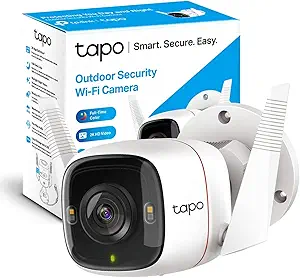
Sharp 2K, free person alerts, and a card slot instead of a bill
Tapo 2K+ Outdoor Wired Security Camera -
A wired 2K camera that sorts people, pets, and vehicles without a plan, records around the clock to a microSD card, and shoots in color after dark. It covers the front of a house or a driveway well, and it doesn't nag you to upgrade.
$41.99fromAmazonThe alerts you actually want don't cost anything here. Plenty of cameras dangle person detection and then park it behind a plan. This one separates people, pets, and vehicles for free, and you can draw activity zones so the public sidewalk stops setting it off. That's the difference between glancing at your phone twice a day and muting the app forever. If you've already turned off notifications on an older camera out of sheer annoyance, start here.
2K gives you enough pixels to recognize somebody, not just notice them. At 4MP, a face at the end of a driveway is still a face when you zoom into the recording. A 1080p camera turns that same person into a smudge in a hoodie. You won't read a plate across the street, because nothing this size does. But you'll know whether that's your neighbor's car or one you've never seen before.
Night is where it pulls ahead. A starlight sensor plus two built-in spotlights means color video after dark instead of the usual gray infrared wash, and the IR reaches about 98 feet when you leave the lights off. Color matters more than people expect. A red jacket and a blue jacket look identical in infrared, and that's exactly the detail anyone taking a report will ask you for.
It records around the clock, and the footage stays on your shelf. Slide in a microSD card and it keeps continuous local video, so there's no gap between clips and nothing to retrieve from someone else's server. The IP66 housing shrugs off driving rain and road grit. You also get a siren and two-way talk, plus Alexa and Google support if you want the feed on a smart display.
Flaws but not dealbreakers
It needs a wire, and that decides where it can go. This is a wired camera with a power run to plan, so a fence post at the back of the yard is off the table unless you're willing to pull cable. Sort out the mount before you order. Getting the angle right on a soffit with a drill in one hand is the genuinely hard part of the job.
The app is the weak spot. Owners regularly report the live view lagging a few seconds behind reality, and homes with mesh systems or several access points sometimes see the camera drop and need a reconnect. None of that is fatal. But if your network is finicky, plan on an evening of fiddling rather than the few minutes the box promises.
The housing is plain plastic. It's weatherproof and it holds up in the sun, but it won't survive somebody with a bat the way a metal dome will. On a second-story eave that's a non-issue. For a storefront, a low wall, or an alley, look at the PoE picks further down instead.
Runner-upOn sale
4K and solar power, so you can mount it far from an outlet
REOLINK First 4K Solar Security Cameras Wireless
A solar-charged pan-and-tilt camera that shoots 4K and swings 355 degrees to follow movement. It's the one to buy when the spot you want covered has no power, no ethernet, and no easy way to get either.
$134.99fromAmazonList priceYou can put this where electricity doesn't reach. It runs on a battery topped up by a small solar panel, so a barn, a side gate, or the far corner of a lot is suddenly fair game. Reolink says it needs only a short stretch of daily sun to stay charged. Aim the panel south, keep a branch from shading it at noon, and you shouldn't be dragging a ladder out to swap batteries.
It shoots 4K, which is unusual for anything living on sunlight. 8MP gives you real cropping room after the fact. You can pull in on a face or a bumper inside the saved clip instead of wishing you'd aimed the camera two feet lower. A motion-triggered spotlight keeps that detail in color at night rather than dropping to infrared gray.
The pan and tilt earns its place. 355 degrees of rotation and 140 of tilt let one mount cover a driveway, a walkway, and a side yard, and auto-tracking follows a person across the frame instead of catching them on the way out of it. If you were about to buy two cameras for one corner of the property, this is the cheaper way through.
Wi-Fi 6 on both bands matters more than it sounds like it should. Battery cameras usually crawl along on 2.4 GHz and stutter when the video gets big. This one takes 5 GHz too, which you'll feel every time you open a 4K live view on your phone. Detection is tunable by zone and by person, vehicle, or pet, and events record to a microSD card you supply.
Flaws but not dealbreakers
4K fills a card fast. Every saved event is a large file, and a modest microSD will start overwriting sooner than you'd like. Buy the biggest card it supports on day one. Otherwise you'll go looking for something from last week and find it already got recycled to make room for the mail carrier.
Moving parts are parts that can fail. A pan-tilt head has motors and gears sitting outside through freeze-thaw cycles and blowing grit, and owners of this style of camera commonly report the mechanism turning noisy or sticky over a couple of seasons. It also can't watch everything at once. While it's pointed at the driveway, the back gate is nobody's problem.
Solar isn't magic in a northern winter. Short days, a low sun angle, and a dusting of snow on the panel all cut the charge going in, and heavy motion traffic drains it faster. If you live somewhere gray from November onward, expect to bring it inside and charge it by hand at least once a season.
Budget pickOn sale
Color video after dark and nonstop recording, if you can wire it
WYZE Cam v3 with Color Night Vision
A tiny wired camera that costs a small fraction of the others here and still shoots color at night and records continuously to a card. It's the one to buy when you want three or four cameras instead of one.
$32.98fromAmazonList priceIt costs a fraction of everything else here and still shoots color after dark. The starlight sensor and fast f/1.6 aperture pull in far more light than a typical budget camera, so a porch lit by one bulb comes out in color instead of infrared gray. That's a feature premium brands charged a lot for not long ago. Here it's the headline on a budget camera.
Continuous recording is rare at any price, and this one includes it. Drop in a 32GB microSD card and it records 24/7, not just short motion clips. That means no missing seconds between events, which is exactly when the interesting thing tends to happen. If you want a straightforward local record of your driveway all night, this does it without a plan.
Buying several is realistic. Because each one is so inexpensive, you can cover a side door, a garage, and a back deck for less than one premium camera. Coverage beats resolution more often than people think. Three angles at 1080p will tell you what happened; one gorgeous 4K view of the wrong corner won't.
It plays nicely with the rest of your house. It works with Alexa, Google Assistant, and IFTTT, and detection covers both motion and sound with adjustable zones and sensitivity. You can dial it down so the street doesn't trigger it, or turn detection off in a zone entirely. The app is simple enough that a housemate will actually use it.
Flaws but not dealbreakers
Outdoors it isn't quite plug-and-play. The camera is rated IP65, but Wyze requires its own outdoor power adapter for outside use, and that's sold separately. Factor it in before you assume this is the simple option. You're also tethered to an outlet, so placement is limited to wherever you can hide a cable.
1080p is the ceiling, and you'll feel it. For a porch at close range it's plenty. Across a yard, faces get mushy and details you'd want later just aren't in the file. The plastic build is fine rather than sturdy, and it looks like what it costs.
The free cloud tier is nearly a gesture. Clips top out at 12 seconds with a five-minute cooldown between them, which is how a slow event turns into a highlight reel with the good part missing. Treat the microSD card as the real storage and the cloud as a bonus, or the free tier will push you toward a plan.
Upgrade pick
True 4K over one cable, if you'll do the network work
Amcrest UltraHD 4K
A metal-domed 4K PoE camera built for permanent installation, with one ethernet cable carrying both power and video. It asks more of you at setup and gives back a picture and a reliability level the wireless cameras can't match.
$89.99fromAmazonThis is the picture quality the rest of the list is approximating. A Sony Starvis 8MP sensor at 3840x2160 with a 112-degree view means you can cover a whole driveway and still crop into a face in the recording. Low-light performance comes from the sensor rather than from a spotlight blasting the scene. If identification is the actual goal, this is the pick.
One cable does power and video, and it doesn't drop. Power over Ethernet removes the two things that break other cameras: a Wi-Fi signal that fades in bad weather and a battery that dies in January. Run one line to the eave and the camera simply stays up. For a rental, a shop, or a house you'll be in for a decade, that reliability is the whole argument.
It's built like equipment rather than like a gadget. The housing is metal, rated IP67 against weather and IK10 against impact, in a dome shape that's hard to grab and twist away from what it's watching. Night vision reaches about 98 feet on built-in IR. Mounted eight feet up on a garage, it will look the same in five years as it does the day you install it.
Your footage goes wherever you tell it. Record to a microSD card, to an NVR, or to a PC using the included Windows and Mac software, and it works with third-party recording software as well. Nothing has to leave your house. That's a meaningfully different privacy posture than a camera that uploads first and asks later.
Flaws but not dealbreakers
You need network infrastructure, and that's a real project. A PoE switch or injector, a cable run through an attic or along a soffit, and an IP address that stays put. If ethernet in your walls sounds like someone else's job, it probably is, and you should take the Tapo instead.
The setup screens assume you know what you're doing. Configuration is dense with settings like tripwire and intrusion zones, and getting alerts tuned takes patience rather than a wizard. Owners who came from a phone-first camera app tend to find the first afternoon frustrating. Once it's dialed in, you leave it alone for years.
There's no wireless option, and the frame rate is modest. It records at 20 frames per second, which is fine for identifying a person and less good for tracking fast motion smoothly. And because it's wired only, every placement decision is a cable decision.
Amcrest covers the camera with a one-year US warranty plus lifetime support.
Also greatOn sale
Two lenses and 360-degree coverage from one solar mount
eufy Security SoloCam S340
A solar camera with two lenses working together, one wide and one zoomed, plus pan and tilt for full coverage from a single spot. It's for a porch or driveway where you want both the whole scene and a close look at the person in it.
$139.99fromAmazonList priceTwo lenses mean you don't have to choose between wide and close. One camera holds the whole scene while the other pushes in with 8x zoom, so you get context and detail from the same event instead of picking one at install time. eufy rates the clear range at about 40 feet. Within that, this is one of the better ways to actually identify somebody.
Mounted vertically, it covers a full circle. Pan and tilt take it all the way around, which suits a corner where a front walk, a driveway, and a side gate all need watching. If you've been planning two cameras and two mounting headaches, this collapses the job into one hole in the siding.
Solar plus local storage means no bills and no cables. The removable solar panel keeps it charged, and recordings stay on the camera or on a HomeBase S380 if you already own one. eufy is explicit that there's no monthly fee. Install is genuinely quick since there's nothing to wire.
It suits people who want it handled, not tinkered with. The setup runs from the phone in a few minutes, the mount is compact enough not to dominate a porch, and once the panel is aimed there's essentially no maintenance. For a front entry you look at every day, that matters more than a spec sheet win.
Flaws but not dealbreakers
It's expensive for what it covers. This is among the priciest cameras here, and its useful clarity range is roughly a porch and a driveway rather than a whole lot. If you need to watch something 80 feet out, the money is better spent elsewhere.
The panel placement decides whether you're happy. Solar works only if you get real sun on it daily, and a north-facing wall or an overhanging maple will have you charging it by hand. Scout the spot at midday before you commit to the mount.
There's a lot of app to learn. Between dual cameras, zoom, pan-tilt patrol settings, and detection tuning, the settings run deep. If all you want is an alert when somebody walks up, you're paying for capability you'll never open.
Who this is for
This guide is for you if you want a camera watching a door, a driveway, or a side yard, and you don't want a recurring bill attached to it. That mostly means people covering one to four spots around a house, an apartment entry, or a small shop. If you already pay for a full alarm system with monitoring, you're better off adding that company's cameras, because the integration is worth more than the savings. And if what you actually need is footage of a large property line at distance, you want a wired multi-camera NVR system, which is a different purchase than any single camera here.
It's worth being clear about what subscription-free buys you and what it doesn't. You get your footage on your own storage and no monthly charge. You don't get off-site backup, so a thief who takes the camera takes the card with it, which is a good argument for mounting high and for keeping a second camera aimed at the first. Cellular backup, professional monitoring, and long cloud histories all still cost money on every system we looked at. We also stuck to cameras meant for outdoor mounting, so indoor-only models and doorbells aren't covered.
How we picked
Storage: the camera has to save video to a card, a drive, or a hub you own, with playback that works when you've never entered a payment method. Detection: person and vehicle alerts and custom activity zones should be included, not dangled, since detection behind a paywall is how a fee-free camera becomes a subscription. Picture: we set 2K as the floor for anything expected to identify a person, and we favored starlight sensors and spotlights that hold color after dark. Weather: IP65 minimum, with extra credit for metal housings and vandal-rated domes in reachable spots. Power: solar and battery models had to survive a real winter without weekly babysitting, and wired models had to be honest about what else you'll need to buy.
Other outdoor security cameras without a subscription worth considering
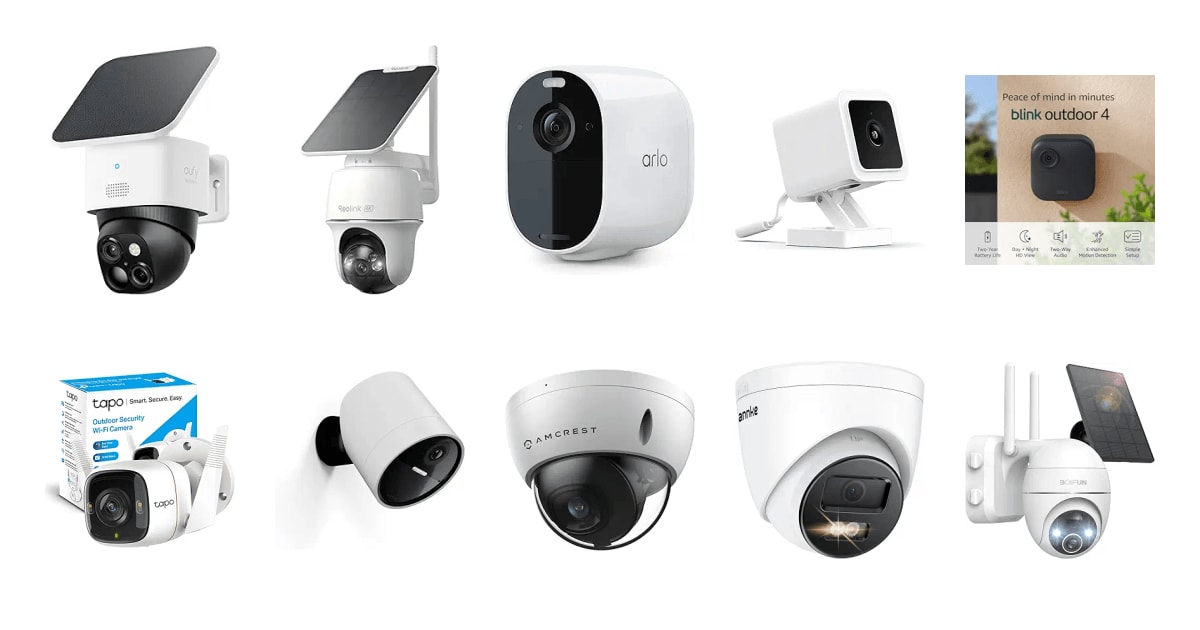
If you want 4K over ethernet with smarter alerts: The ANNKE C800 4K PoE Security Camera with ($71.99) — The ANNKE C800 lands close to our upgrade pick and costs noticeably less. You get 4K over a single PoE cable, on-camera human and vehicle recognition that filters out swaying branches and rain, wide dynamic range for a driveway that's half shade and half glare, and support for cards up to 512GB. Night vision runs about 100 feet with a spotlight assist. What you give up is the metal vandal-rated dome and the polished desktop software of the Amcrest, and the lens is fixed, so a sloppy mounting angle is permanent. Owners also note the AI occasionally miscalls an object in odd light. If you're already running ethernet and want the most resolution per dollar, this is a fine landing spot.
If you want pan-and-tilt solar coverage for a shed or fence line: The Solar Security Camera Wireless Outdoor Wi-Fi — The BOIFUN solar camera pairs a large 15000mAh battery with a panel and a 360-degree PTZ head, plus 2K video, color night vision, a spotlight, a siren, and two-way audio. For a detached garage, a gate, or a driveway with no power nearby, it covers a lot of ground for what it costs, and the big battery means it can coast through a gray week. The trade-offs are real: it's bulky and obvious on a wall, the app feels a generation behind the ones from Tapo and Reolink, and image quality is decent rather than sharp. Solar output also swings a lot with season and mounting angle. Buy it as an inexpensive second or third camera, not as the one guarding your front door.
The competition
Here's what else our research surfaced. This isn't every camera sold without a subscription, and it isn't a ranking of everything on the market. These are the models that came up repeatedly alongside our picks and that we compared closely on specs, published reviews, and owner feedback before setting them aside.
The Arlo Essential Spotlight Camera - Wireless Security — The Arlo Essential Spotlight Camera is genuinely easy to live with. It connects straight to Wi-Fi with no hub, mounts in minutes, and the built-in spotlight gives you color night video with two-way audio and 1080p across a 130-degree view. The problem is where the smarts live. Arlo's package, vehicle, animal, and person alerts come with a paid plan, and there's no local card slot, so a fee-free Arlo is a camera that pings you about motion and not much else. Battery life also swings a lot with traffic and drops in cold weather. Choose it if you already run Arlo elsewhere and want matching hardware, and accept that you'll probably end up paying.
The Blink Outdoor 4 ($99.99) — The Blink Outdoor 4 is the low-maintenance champion, with up to two years on the included AA lithium batteries, dual-zone motion detection, 1080p live view, and two-way talk. This two-camera kit is a cheap way to cover a garage and a back door. But it fits this guide awkwardly. Person detection requires a Blink plan, night vision is infrared only rather than color, and local backup means the Sync Module 2 plus a USB drive you supply. Video quality is adequate and no better. If you want cameras in spots you'd rather never climb up to again, this is the one. Just know the smart alerts aren't part of the deal.
The SimpliSafe Wireless Outdoor Security Camera ($189.97) — The SimpliSafe Wireless Outdoor Security Camera is a good camera in the wrong guide. It installs in about five minutes with no wiring, covers 140 degrees at 1080p with 8x zoom, and adds a spotlight for color at night. Inside a SimpliSafe system it shines, kicking off recordings during an alarm so you can see what tripped it. On its own it's hobbled, because saving recordings needs a SimpliSafe plan and there's no local storage at all. That makes it the least subscription-free option here despite the price. Buy it if you already own the alarm system. Otherwise almost anything else on this page serves you better.
Installation notes
Mount high enough that nobody can reach the camera, and angle it down across the path someone would walk rather than straight at the driveway. A camera pointed head-on gets you the top of a hood; one angled across the approach gets you a face. Keep the lens out of direct sun and away from a porch light, since both wash out the image. Wipe the lens and, on solar models, the panel every couple of months, because spider webs and pollen film cost you more clarity than any spec on the box. Check that motion zones exclude the street and any branch that moves in the wind. And test playback from your card twice a year, before the week you need it.
Questions we get
Do cameras without a subscription still get smart alerts?
Some do and some don't, and it's the single biggest thing to check before buying. The Tapo C320WS includes person, pet, and vehicle detection with custom zones at no cost, and the ANNKE C800 does human and vehicle recognition on the camera itself. Blink and Arlo, by contrast, put person detection behind their plans. Assume nothing from the marketing and look for detection listed as included.
Where does the footage actually go if I'm not paying for cloud storage?
Onto storage you own. Most cameras here take a microSD card, and capacities vary widely, with the ANNKE C800 accepting cards up to 512GB. The Amcrest can also record to a network video recorder or to a PC using its included software, and Blink backs up to a USB drive through its Sync Module. Cards are almost never included, so budget for one.
Are solar cameras reliable through winter?
Mostly, with caveats. Reolink and eufy both design for year-round operation and need only a short stretch of daily sun to hold a charge, and the batteries carry several days on their own. Where it breaks down is a run of heavy overcast, a shaded mount, or snow sitting on the panel. If you live somewhere genuinely gray from late fall on, plan to hand-charge it once or twice a season.
Can I watch the live view remotely without paying?
Yes. Every camera here streams live and lets you play back local recordings through its own app at no charge. What a subscription usually adds is cloud history, off-site backup, and smarter alert categories. You'll still need decent Wi-Fi at the camera and a reasonable upload speed at home for the live view to feel responsive.
What's the difference between PoE, battery, and solar cameras?
PoE cameras like the Amcrest and the ANNKE pull power and data through one ethernet cable, which is the most reliable setup and the most work to install. Battery cameras like the Blink go anywhere and need charging or new batteries on a schedule. Solar models like the Reolink and eufy split the difference: wire-free placement with a panel doing the recharging, as long as the spot gets sun.
Do these work with Alexa and Google Assistant?
Many of them do. The Wyze Cam v3 works with Alexa, Google Assistant, and IFTTT, and the Tapo C320WS works with Alexa and Google, including putting the feed on a compatible smart display. Blink integrates tightly with Alexa. The PoE cameras are the exception, since they're aimed at recorder software and desktop apps rather than voice assistants.
Why you should trust us
For this guide:
- We read manufacturer spec sheets and listing details for every camera here, paying particular attention to which features are included outright and which require a plan.
- We compared published reviews of these models against owner feedback themes, especially around night video, app reliability, and how solar and battery cameras hold up in cold weather.
- We did not install or operate any of these cameras ourselves, so every claim above traces back to published specifications, reviews, or patterns in what owners report.
- We read owner reviews on every listing, weighted toward the critical ones, because that is where the recurring failures show up.
- We have a systematic way of automatically fetching the latest prices, so the numbers on this page stay current.
- This is a research-focused guide, so the team may not own every product listed — though we often do own the top winners, which gives us extra context for the recommendations.
- We don't accept free products, and the retailer commission never changes which product we recommend.
Sources
Amazon product listings and owner reviews for all 10 products
Manufacturer specification pages for each product
Some passages in this guide may be paraphrased with AI help. Prices are refreshed automatically.
More like this.
Continue exploring electronics reviews and recommendations.

The Best Trailer Wiring Harness Adapters
Trailer wiring is the part of towing nobody thinks about until the lights don't work. You hitch up the boat trailer at 5 a.m., flip on the turn signal,…

The Best Smartwatches and Fitness Trackers
A smartwatch earns its place on your wrist in small moments. It taps you when a text lands so you don't dig out your phone. It counts a swim, logs a run,…

The Best Vinyl Car Wrap Films
A color change used to mean a paint booth, a week without your car, and a bill that made you wince. Vinyl changed that. You can wrap a hood in an…

The Best Car Polishers And Orbital Buffers
Swirl marks show up in direct sun as a spiderweb of fine scratches across your hood and doors. They come from washing, drying, and automatic car washes,…

The Best Collapsible Trunk Organizers
Your trunk is where order goes to die. A bag of groceries tips over on the first left turn, a jug of washer fluid rolls into the spare tire well, and the…

The Best Noise-Cancelling Headphones for Focus and Deep Work
Most of us don't get to pick where we work. The open-plan office hums, the espresso machine shrieks, and the guy two desks over takes every call on…